
|
Attention Deficit Hyperactivity Disorder (ADHD) is a disorder that affects one in 30 children, to differing degrees, for the entire life-span. Family life, social conformity, mental health and success in school and the workforce are compromised due to the impact of the disorder. A significant number of ADHD children have also been diagnosed as learning disabled, with reading disability being the most common co-morbid learning disability. Whether the reading difficulties experienced by ADHD children are unique, in that they are due to the specific action of ADHD characteristics, or are separate disabilities is currently under debate. However, it is likely that the reading disabilities experienced by ADHD children are the result of the impact of the core characteristics of the disorder on executive functions.
This paper provides a 'snap-shot' of current perceptions regarding the nature of Attention Deficit Hyperactivity Disorder (ADHD), an overview of current medical and educational interventions for the disorder, and describes a reading intervention designed to address the impact of executive function deficits in the reading process. The intervention strategy uses a combination of cognitive training, strategy training and medication in a multimodal intervention to improve the reading behaviour of ADHD children and promote associated reading achievement.
Since these early identifications of the disorder both the label and the diagnostic requirements have changed several times. The current publication of the American Psychiatric Association's (APA) Diagnostic and Statistical Manual of Mental Disorders (DSM-IV) published in 1994 saw further changes to the labelling of the disorder with three subtypes being established. The subtype ADHD-Predominantly Inattentive Type (ADHD-PI) allows a distinction of the disorder where inattention is the principal source of problems. ADHD-Predominantly Hyperactive-Impulsive Type (ADHD-PHI) distinguishes the disorder where the main problem area is hyperactivity-impulsivity with some or none of the symptoms of inattentive behaviour. The ADHD-Combined Type (ADHD-C) is used to describe the disorder where both inattention and hyperactivity-impulsivity are evident. The combining of hyperactivity and impulsivity reflect current findings where these two symptoms are beginning to be seen as one behaviour dimension rather than two separate problem areas. (Barkley, 1996).
The great majority of children diagnosed as ADHD are boys, making up 60-90 per cent of children classified with the disorder. This occurs despite studies showing that males and females have the same genetic predisposition to the disorder (Hay & Levy, 1996). Gross (1997) believes that ADHD occurs with equal frequency in both males and females with differences in the manifestation of the disorder between genders resulting in the differing prevalence rates. Females with ADHD are less likely to be hyperactive (Gross, 1997), aggressive, sensation seeking (Goodman & Poillion, 1992), and present with conduct disorders, but are more likely to be socially withdrawn (Baker, 1994). As a result females tend to be less visible than males and so do not prompt the same number of referrals as their male counterparts (Epstein, Shaywitz, Shaywitz & Woolston, 1991). The difference in prevalence rates between genders is an important issue as it affects the behavioural and educational support available to unidentified ADHD females.
ADHD adults also have a high co-morbidity rate of conduct disorders as well as depression and anxiety disorders, and when ADHD occurs concomitantly with Conduct Disorder (CD), these persons have an increased risk of developing personality disorders (Hay & Levy, 1996). Attempted and successful suicide rates are also higher (Wodrich, 1994), as are substance abuse rates (Hay & Levy, 1996), police contact in relation to traffic offences and speeding (Gordon, 1994), and court involvement related to theft and physical aggression (Wodrich, 1994). For ADHD adults who experienced ADHD symptoms concomitantly with learning disorders and CD as children, the possibilities of achieving a near normal adult life is further diminished with these individuals most likely to have greater on-going problems in adulthood (Gordon, 1994).
ADHD has been found to be highly heritable. The Australian Twin ADHD Project, begun in 1991, showed that between 75 per cent and 90 per cent of ADHD is inherited (Hay & Levy, 1996). This being the case, it is likely that more than one member of the immediate family will be affected by the disorder, with at least one parent having the disorder also a possibility. Since the outcome of the disorder is significantly influenced through environmental factors relating to the home and family pattern of interaction (Barkley, 1996; Wodrich, 1994), treatment packages should consider family support, including training in behaviour management and counselling support. Stimulant medication, specific developmental issues, behaviour management and educational management should also be considered as part of a multimodal approach to treatment (National Health and Medical Research Council, 1997).
| General intervention | Source |
| Allow for active responding | Barkley, 1989 |
| Allow movement between and during tasks | Zentall, 1993 |
| Use tasks with embedded stimulation | Zentall, 1993 |
| Use novelty such as gamesas well as changes in settings, resources and presentation modes | Zentall, 1993 |
| Use reinforcement such as a token economy to reward on-task behaviour | Fiore, Becker & Nero, 1993 |
| Provide tasks that have an appropriate level of difficulty | Zentall, 1993 |
| Maintain a structured schedule as far as possible | Ostoits, 1999 |
| Be consistent with instruction methods | Ostoits, 1999 |
| Use tasks with multisensory features | Ostoits, 1999 |
| Use visual/graphic representations of information and concepts | French & Andretti, 1995 |
| Provide activities that can be divided into smaller tasks | Zentall, 1993 |
| Teach organisational and study skills | Yehle, 1998 |
| Highlight important information in directions | Yehle, 1998 |
| Provide a supportive and risk-taking learning environment | Yehle, 1998 |
| Support for verbal responses during class interactions such as 'think time', verbal or visual scaffolding | Saunders & Chambers, 1996 |
| Task/subject specific intervention | Source |
| Mathematics Peer Tutoring | Hook & DuPaul, 1999 |
| Handwriting Colour added to difficult stroke sequences | Zentall, 1993 |
| Spelling Colour added for difficult stroke sequences Computer Assisted Instruction | Zentall, 1993 Fitzgerald, Fick & Milich, 1986 |
| Reading Pre-reading and post-reading strategies to improve comprehension Quietly reading aloud during Silent Reading to maintain attention Using a marker to maintain place when reading One-to-one and small groups instruction in specific reading skills Self-assessment of taped oral reading to improve auditory discrimination Use of predictable 'join-in' texts to improve auditory discrimination |
Warren & Flynt, 1995 Ostoits, 1999 Ostoits, 1999 French et al., 1995 French et al., 1995 Warren et al., 1995 |
Support for the idea of executive function deficits in ADHD children is found in work where ADHD children have been identified as having difficulty carrying out strategies when working on tasks (Douglas, 1980), being less able to communicate the strategies they use to others (Saunders et al., 1996) and lacking the metacognitive abilities needed for the planning and evaluation of current cognitive strategies. Cited difficulties with memory (Conte, 1991; Saunders & Chambers, 1996) are further indications of executive function deficits since working memory is considered to be one aspect of these functions.
Barkley (1996) has developed a theoretical model of ADHD that provides further insight into the role of executive functions in causing ADHD behaviours. This model is represented in figure 1. The model places inhibition as the primary executive function that affects four other executive functions, that of working memory, self-regulation of affect/motivation/arousal, internalisation of speech, and reconstitution. These secondary functions are dependent on inhibition for their optimal operation. However, the quality of the primary function of inhibition can be influenced through changes in quality of any or all of the second order functions, with all the executive functions being interactive.
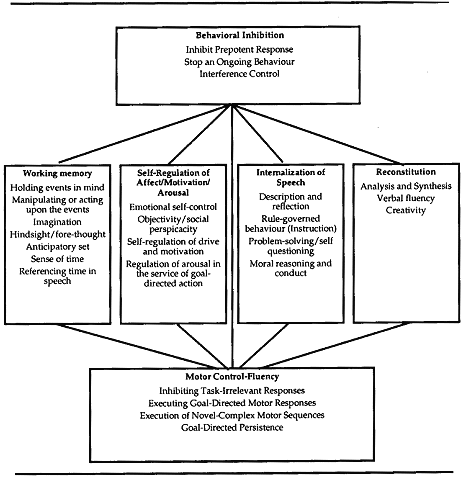
Figure 1: Barkley's (1996) model linking inhibition, executive function and motor-control fluency
An analysis of the executive function deficits experienced by ADHD children indicate that these deficits would impact on the reader's ability to recall and apply relevant background knowledge, as well as the capacity of executive control functions to monitor the meaning construction process. Motivation to initiate and maintain reading effort would also be difficult to achieve. The result is likely to be an underachieving child who views themself as a non-reader and reading as a threatening and unenjoyable experience. A model based on Barkley's model of executive function deficits is displayed in figure 2. This model shows the impact of executive function deficits on the reading process.
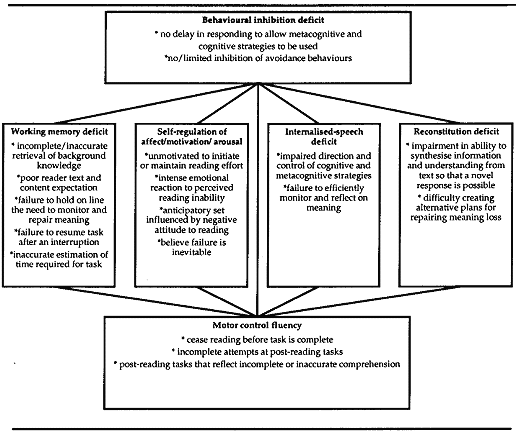
Figure 2: The effects of executive function deficits on the reading process
First, the intervention enhances the executive function of inhibition through the direct action of stimulant medication, self-instruction and self-monitoring. Stimulant medication causes a reduction in 'disinhibition' creating a delay in responding. Self-instruction, which is the self-verbalisation of the steps undertaken when engaged in a task (Conte, 1991), acts to cause a delay in responding as it directs the child to engage in thoughtful responses. In using self-instruction the student focuses on the self-statements needed to prepare for reading, such as 'What do I know about the topic of this book?' and 'What do I know about how the book is organised?'. To initiate and maintain monitoring of meaning construction statements the child is taught to ask such questions as 'Does this make sense?' and the student is encouraged to select and assess appropriate repair statements like 'This doesn't make sense, I'll try the read-on strategy'. Self-monitoring creates planned pauses in action, to allow for structured reflection on strategic reading behaviour. This cognitive approach focuses on the reader's use of reading strategies during the reading of a text. Inhibition is indirectly acted on by self-reinforcement as this component supports the process of self-monitoring.
The action of working memory is directly supported through self-instruction and the visual and kinaesthetic strategy cues of a memory-cue bookmark. The pre-reading self-statements appear on the bookmark and activate the retrieval of relevant background knowledge about text content and structure, allowing the development of a useful anticipatory set. Self-statements such as 'Does this make sense?' during reading help to hold-on line the need to monitor for meaning. The bookmark is likely to prompt action when meaning loss is detected as it reminds the reader of meaning repair actions. Retention of the repertoire of fix-up strategies in working memory is also facilitated through use of the bookmark. Using both visual and kinaesthetic cues on the bookmark provides the multisensory input required by ADHD children (Ostoits, 1999).
Self-regulation of affect/motivation/arousal is directly supported by self-reinforcement and conditional strategy training. Self-reinforcement is designed to increase motivation to engage in the training process and modify reading behaviours. Training in the value of strategy use also increases motivation to act strategically (Paris & Oka, 1986). Self-monitoring also influences affective change as it supports attribution of success to changed reading behaviours by making these changes explicit and assessable. This aims to cause an increase in self-efficacy and the development of a positive attitude to reading (Paris et al., 1986).
Internalisation of speech is enhanced directly through cognitive training in self-statements, which is supported by strategy training and self-monitoring. The cognitive training process facilitates the development of effective internal speech. It provides self-statements that are able to efficiently and effectively direct and control cognition and provides support for the child as they move to internal use of the statements. Strategy training informs self-statements so that readers are able to incorporate statements of action specific to the reading process. Self-monitoring promotes the use of appropriate self-statements as it provides a means of self-reflection and evaluation of quality and effectiveness of these statements. Use of self-instruction and self-monitoring is further supported by self-reinforcement.
The capacity for reconstitution is enhanced through the action of all intervention components as they influence the reading process and so increase comprehension. This change is likely to improve the reader's ability to use information and understanding from texts to create novel responses. The ability to create multiple plans of action also is likely to improve since strategy training provides an array of strategies from which to choose and self-instruction acts to direct and control the development of plans and strategies.
In summary, the intervention provides a multimodal approach that addresses the academic needs of the ADHD reader as well as the executive function deficits associated with ADHD. It provides the tools to access text (strategies), a means of controlling cognition during reading (self-instruction), and promotes the attribution of success to the actions of the reader. In doing so it establishes affective and cognitive conditions conducive to successful reading. Once initial training is mastered by the student, the intervention should be relatively easy for the classroom teacher to maintain by continuing the self-reinforcement system, managing the resource materials including access to interesting texts appropriate to the reader's ability, and the memory-cue bookmark.
When attempting to meet the needs of ADHD children in the classroom, teachers need to provide interventions that are able to be maintained and extend the ideas described above to other subject areas since ADHD children often have difficulty generalising learning strategies from one context to another. Identification of ADHD girls also needs to be addressed as an educational priority, particularly if the disorder has already been identified in another member of the family. It is the aim of inclusive education for all children to achieve to the best of their ability. Providing ADHD children with appropriate interventions will facilitate the achievement of this goal.
American Psychiatric Association. (1994). Diagnostic and Statistical Manual of Mental Disorders IV.
Baker, J. (1994). Attention Deficit Hyperactivity Disorder: A creation of the medical profession? Australian Journal of Guidance and Counselling, 4 (1), 65-80.
Barkley, R. (1989). Attention Deficit Hyperactivity Disorder. In E. Mash & R. Barkley (Eds), Treatment of childhood disorders (pp. 39-72). New York: The Guilford Press.
Barkley, R. (1996). The North American perspective on Attention Deficit Hyperactivity Disorder. The Australian Educational and Developmental Psychologist, 13 (1), 2-23.
Cantwell, P., & Baker, L. (1991). Association between Attention Deficit Hyperactivity Disorder and learning disabilities. Journal of Learning Disabilities, 24 (2), 88-95.
Conte, R. (1991). Attention disorders. In B. Wong (Ed.), Learning about learning disabilities (pp. 59-101). San Diego: Academic Press.
Douglas, V.I. (1980). Higher mental processes in hyperactive children. In K.R.M. & D.J. Bakker (Eds), Treatment of hyperactive and learning disordered children: Current research (pp. 65-91). Baltimore: University Park Press.
Epstein, M., Shaywitz, S., Shaywitz, B. & Woolston, J. (1991). The boundaries of Attention Deficit Disorder. Journal of Learning Disabilities, 24 (2), 78-86.
Garner, R. (1994). Metacognition and executive control. In R. Ruddell, M. Ruddell & H. Singer (Eds), Theoretical models and processes of reading (pp. 715-732). Newark, Delaware: International Reading Association.
Goodman, G. & Poillion, M. (1992). ADD: Acronym for Any Dysfunction or Difficulty. The Journal of Special Education, 26 (1), 37-56.
Gordon, C. (1994). Attention Deficit Hyperactivity Disorder: Issues for special educators. Australasian Journal of Special Education, 18 (2), 36-49.
Grainger, J. (1997). Children's behaviour, attention and reading problems. Melbourne: The Australian Council for Educational Research.
Gross, M. (1997). The ADD brain. New York: Nova Science Publishers.
Hay, D. & Levy, F. (1996). The differential diagnosis of ADHD. The Australian Educational and Developmental Psychologist, 13(1), 69-78.
National Health and Medical Research Council. (1997). Attention Deficit Hyperactivity Disorder (ADHD). Canberra: Australian Government Publishing Service.
Ostoits, J. (1999). Reading strategies for students with ADD and ADHD in the inclusive classroom. Preventing School Failure, 43 (3), 129-134.
Paris, S. & Oka, E. (1986). Self-regulated learning among exceptional children. Exceptional Children, 53 (2), 103-108.
Purvis, K. & Tannock, R. (1997). Language abilities in children with attention deficit hyperactivity disorder, reading disabilities, and normal controls. Journal of Abnormal Child Psychology, 25(2), 133-145.
Rosenblatt, L. (1994). The transactional theory of reading and writing. In R. Ruddell, M. Ruddell & H. Singer (Eds), Theoretical models and processes of reading (pp. 1057-1092). Newark, Delaware: International Reading Association.
Ruddell, R. & Unrau, N. (1994). Reading as a meaning-construction process: The reader, the text, and the teacher. In R. Ruddell, M. Ruddell & H. Singer (Eds), Theoretical models and processes of reading (pp. 996-1056). Newark, Delaware: International Reading Association.
Rumelhart, D. (1994). Toward an interactive model of reading. In R. Ruddell, M. Ruddell & H. Singer (Eds), Theoretical models and processes of reading (pp. 864-894). Newark, Delaware: International Reading Association.
Saunders, B. & Chambers, S. (1996). A review of the literature on attention deficit hyperactivity disorder children: Peer interactions and collaborative learning. Psychology in the Schools, 33 (4), 333-340.
Wodrich, D. (1994). Attention deficit hyperactivity disorder: What every parent wants to know. Baltimore: Paul H. Brookes.
Zentall, S., Gohs, D. & Culatta, B. (1983). Language and activity of hyperactive and comparison children during listening tasks. Exceptional Children, 50 (3), 255-266.
| Author details: Kathy Baker is working on a PhD thesis at Central Queensland University entitled 'Managing the impact of ADHD on reading achievement'. Before working full-time on her thesis was a classroom teacher. It was through dealing with the real impact of ADHD, on both the individual and the whole classroom, that sparked Kathy's interest in pursuing a research study in this area. (email: k.baker@cqu.edu.au)
Please cite as: Baker, K. B. (2001). Attention deficit hyperactivity disorder and reading achievement. Queensland Journal of Educational Research, 17(1), 68-84. http://education.curtin.edu.au/iier/qjer/qjer17/baker.html |